Broomhead Hall
- a brief history
- a tour of the building
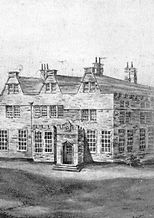

A Brief History of Broomhead Hall
John Wilson the Antiquary's Collection
A BRIEF HISTORY OF BROOMHEAD HALL
Within living memory there was a large mansion house situated by the hamlet of Wigtwizzle, between Bradfield and Bolsterstone, known as Broomhead Hall, on the edge of the famous Broomhead Grouse Moors. The house had been built in 1831 on the site of an earlier house dating from 1773, the latter replacing one which had been erected in 1640 by Christopher Wilson. Stones bearing these dates, together with one bearing the date 1311, were at one time placed in the west porch of the final (1831) building by one of the Rimington Wilsons. There is no information on a house built in 1311, and it is possible that this datestone came from another, smaller house in the same vicinity. It is a real shame that Broomhead Hall was demolished in the 1970s.
The historian Joseph Hunter wrote that, “Bromhead, or le Bromyheved […] is an ancient freehold estate of inheritance within the great Manor of Sheffield […] situated near the springs of a little stream which waters a retired valley called Ew-den, from the yew-trees which formerly abounded it. From the house which was erected at Bromhead, in which the family of Wilson for many centuries resided, there is a beautiful view along the valley to the abrupt ascents and woods of Wharncliffe.” The Rev. R. A. Gatty, who was the Rector of Bradfield from 1869-1888 [1] said, “Of Broomhead Hall itself, too much can hardly be said in its praise […] It is an intellectual oasis in the midst of wood and moors, as well as the centre of some of the best shooting in Yorkshire.”
In his book “Hallamshire,” Joseph Hunter prints a pedigree drawn up by John Wilson the Antiquary of Broomhead Hall, showing that the family was local as far back as the 1200s, in the reign of Edward I, who reigned from 1278-1306. Hunter made much use of documents collected by John Wilson (1719-1783), which date back centuries. He was born exactly four weeks after Mr. Wilson’s death, and died in 1861.
The 1640 Broomhead Hall
The Wilsons lived in this area for hundreds of years, but no one seems to know their exact location. The 1640 house is often referred to as the first Broomhead Hall, there being no information about any earlier houses. It was built, or possibly re-built, by Christopher Wilson (1595-1671) [2] between 1635 and 1640, during the reign of Charles I. John Hawley, of Thorn House, was the master mason, and the workmen received one penny a day or a peck of corn. Christopher had married Mary Ibbotson in 1623, the daughter of the Rev. John Ibbotson of Wigtwizzle. In 1635 Christopher went to live at Wigtwizzle in the house of his father-in-law while Broomhead Hall was being built. It was completed in 1640. Mary was said to have had quite a reputation for the quality of her home-brewed ale, and so great was her renown as a prudent and accomplished housewife that the daughters of well-to-do families were often placed under her care and tuition.
Christopher Wilson was a staunch Puritan and was a Captain in the Parliamentary Army during the Civil War of 1642-1651. Hunter states that he could find no evidence for him being a Captain, although a contemporary of Christopher’s, Captain Adam Eyre of Hazlehead near Penistone, calls him Captain in his diary. Eyre kept a diary, which contains lots of local references, and on the 24th August 1647 he recorded that, “after dinner Captain [Christopher] Willson’s sonne and I and some others went and drunk at Bever’s.”[3]
Once, when Christopher was away from home, his wife and her retainers successfully defended the house at Broomhead against a small body of the King’s soldiers. An oak door survived which was embedded with the stones which had been fired at it. Pikes were also in existence which were said to have been used by the defenders of the house. Joseph Kenworthy wrote that some of these pikes were, at the time of writing (1922) preserved in the porch at “Waldershaigh,” Bolsterstone, which was then the home of Reginald T. Wilson.
Previous to the Civil War, Christopher had refused to appear to receive the honour of a Knighthood at King Charles I’s coronation, and on the 25th September 1630 he paid a fine of £16 for his non-appearance. The Bank of England’s Inflation Calculator estimates this to equate to over £3,000 today.
Christopher’s estate was settled on his second son, Charles Wilson, a vicar, in 1659. Christopher died in 1671. The Hearth Tax Returns for 1672 record that Mr. Wilson paid tax on 8 hearths, the most hearths recorded in the Westnall and Waldershelf area. Many houses had only one or two hearths, and there were a great deal of exemptions from the tax for the poor.
[1] Son of the Rev. Dr. Alfred Gatty, vicar of Ecclesfield
[2] Christopher Wilson’s date of birth is sometimes given as 1594 and sometimes as 1595. This confusion comes from the fact that he was baptised at Bradfield on the 1st March 1595, which was entered in the Parish Register as 1594; until the year 1752 the New Year was reckoned from 25 March, so any baptisms from 1 January until 25 March 1595 are recorded under the year 1594, with baptisms from the 26th March being entered as 1595. To make this clear, the accepted form nowadays is to write these baptisms showing both dates. In this instance 1 March should be written as 1 March 1594/5.
[3] I originally found this quote in a newspaper article by Joseph Kenworthy, where the name Bever (Beever or Beaver) was written as Vever. Vever is a real surname, but there were no instances of it locally at this time. I managed to track down a copy of the Diary and the name was Bever, quite a common surname in the Penistone district.
The 1773 Broomhead Hall
The house was rebuilt and enlarged by Christopher’s great-grandson John Wilson the Antiquary in 1773. John was the son of the vicar Charles Wilson M.A. John’s son, also called John, lived in London where he was a solicitor, and when he died in 1809 or 1810 he left the estate to his wife Rebecca, who sold it to Henry Wilson of London, a relative from a younger branch of the same family.
The 1831 Broomhead Hall
Henry Wilson does not seem to have lived at Broomhead; according to the Wilson pedigree printed in Hunter’s Hallamshire (published in 1819) he was a merchant in the City of London. Instead, he put his nephew James Rimington, the son of his sister Mary Wilson, in charge, and it was James who oversaw the redevelopment of the Hall, which was finished in 1831. Country Life described it as being in “the gabled Tudor fashion that was then becoming so popular.” Some of the rooms had splendid oak beams to support the ceilings.
Henry Wilson was a bachelor, and when he died in 1835 he left the property to James, on condition that those succeeding him should take the surname of Wilson; hence the occupants became known as the Rimington Wilsons (no hyphen). James was married to Sarah Broomhead and was a barrister. He lived from 1786-1839, dying four years after his uncle.
The cellars of John Wilson’s 1773 Hall were not disturbed when the house was rebuilt, the new house sitting on the foundations of the earlier one. It was built from millstone grit and was a very substantial-looking building, The entrance hall covered the same footprint, but was made much higher. The front door was on the west side of the house.
Writing in 1837, a few years after the completion of the new Hall, John Holland wrote: “Just on the brow of the hill above the bridge, stands Broomhead Hall, the seat of James Rimington, Esq., one of his Majesty’s Justices of the Peace for the West Riding. The house, which appears of good size, is built of excellent dressed stone: the design is mostly derived from what may be called the better domestic style of the time of Elizabeth – half octagon projections, bay windows, gabled roofs, clustered chimneys, and embattled parapet. The interior of the mansion is finished in a style of great richness and beauty: the greater portion of the ground story of the eastern or principal front, is fitted up as a library, and contains a splendid collection of modern books. The situation is delightful – in summer, – overlooking the fine slopes right and left of the Yewden, including the winding channel and glittering curves of the river itself; the whole scene shut in at the bottom of the valley by the vast triangular curtain of Wharncliffe wood. Indeed, it may be remarked, that as this valley lies pretty much in the direction of east and west, filled with a glorious effulgence of that rich mellow light which is poured forth at sunset and sunrise.”[4]
Note: David Hey and Joseph Kenworthy both wrote that Henry died in 1819, but after I was unable to find any record of this I widened the search and found out that he actually died in 1835. I think these two men must have confused Hunter’s pedigree entry for Henry which said that he was “living unmarried in 1819.” He died at his home in Upper Tooting, Surrey in April 1835 aged 76 and his Will was proved at Canterbury on the 1st May.
Note: Fire
When he was interviewed by a local newspaper in 1976, Mr. Reginald Rimington Wilson said that the 1773 building burnt down, but I have found absolutely no proof of this, nor did I find any mention of the rebuilding in the newspapers. However, I did come across reports of a huge fire which very nearly reached the Hall, in 1826. The fire was discovered on the afternoon of Saturday 29 July, and within a few hours more than six acres were burning. At this time there was no fire brigade to call upon, and the fire had to be fought by beating the flames and digging trenches. But despite huge efforts, the fire spread rapidly, and a week later it was still burning with what the Sheffield Independent called “unabated fury.” By the following Saturday it was estimated that 1,500 acres of land had been burnt. Even a fierce thunderstorm, with the rain descending in torrents, did nothing to quench the flames. Gangs of men worked in shifts by day and night to dig trenches deep enough and wide enough to stop the fire from spreading. Frequently, although the fire had been beaten out on the surface of the moor, it would then spread through the crevices in the ground before bursting out like a new fire some 20 or 30 yards away. Sometimes the smoke was so dense it hindered the men in their work.
There were fears that the fire would reach Broomhead Hall, despite it being separated from the burning ground by a road thirty feet wide. Everything that could burn was cleared away, but the locals were frightened for their homes and livelihoods. In the end, the fire did not reach the Hall, one report saying that a change in wind direction had helped.
The cause was thought to be a man who had been out on the moors with others, picking bilberries, and who had thrown away the contents of his smoked pipe onto the ground. He had, apparently, lit the pipe with a “lens,” also known as a burning-glass; the idea was to use the small magnifying glass to focus the sun’s rays onto the tobacco.
Another fire had broken out around the same time on the adjoining moor, Hobson Moss (on the other side of the Duke’s Road from Broomhead Moors), and this fire was thought to have been started by poachers. Overall, in this area, it was thought that between two and three thousand acres of moorland had burnt, some to a depth of two to three feet. The Leeds Mercury of 26 August reported that the moors around Hollow Meadows were also alight, as was the ling [heather] on Wadsley Common and the moors above Chesterfield.
The fire on Broomhead was not properly extinguished until September. The Leeds Mercury of 2 September reported that the moors around Sheffield were still on fire, and “it is feared that the whole of the moors at Broomhead, and in the neighbourhood, will be ultimately destroyed.”
Fires around Goole and Thorne were thought to have been started by someone burning “quicks.” I had to look this up, in the end resorting to Joseph Wright’s English Dialect Dictionary, which says that “burning quicks” refers to the burning of soft meadow-grass, or couch-grass, which is cleared from the land using a horse-drawn harrow and collected in heaps before being burnt on the land.
[4] Holland, John: A Tour of the Don, 1837, pp136-128
Click on a photograph for more information


A TOUR OF THE 1831 HALL
Based on an article written in 1904 and published in the magazine Land and Water, using additional information from newspaper articles and memoires. I have taken slight liberties with the date, adding some information from between 1904 and 1913. The “current owner” referred to is Mr. Reginald Henry Rimington Wilson, born in 1851, a bachelor. After his death in 1927 the estate passed to his nephew Captain Henry Edmund Rimington Wilson (1899-1971).
LOCATION
“After a quick run from London of three hours in a Great Northern express, you arrive at Sheffield, and find your fly waiting for you – with two horses if you are wise, as the hills are very steep – for a drive of twelve miles to your destination. It is difficult to realise as you pass through the smoky town, thronged with crowds of hurrying mechanics, their wives, and very numerous families, that such a thing as a grouse could exist within miles of this smoke and grime, or that any heather could bloom in this neighbourhood; but after driving for two or three miles up the Loxley valley, and gradually mounting the hills to the north, you leave Sheffield and its noise and smoke behind you. As you get higher the air becomes keener and clearer; you seem to feel yourself growing younger and more vigorous, and life seems more worth living than ever. The house is well and solidly built of the grey stone of the country […] It is very comfortable, and stands well, looking down the valley towards Wharncliffe Chase […] The house stands high, being nearly 1,000 feet above the sea; and though you would think that the climate must be very severe, the gardens rather give you the opposite opinion; fruit and flowers thrive remarkably well, and they are kept in beautiful order. One of the great charms of the place is the closeness of the house to the moor; less than 200 yards off you may hear the old cock grouse crowing in the early morning. A short walk through the garden and shrubbery brings you on to the moor …”[1]
[1] Taken from the August edition of the magazine “Badminton,” written by Mr. Arthur Acland-Hood, used in an article in the Daily Telegraph 27 July 1903, p9
It is late spring or early summer, and we approach Broomhead Hall through an avenue of rhododendrons, ablaze with colour …

Postcard by Sheldon
We are looking at the south side of the Hall, and we must go around to the west side of the building where there is an entrance porch - where the car is on the photograph below.

Source: Picture Sheffield ref. y11791, from an album of photographs by C. H. Lea (1942)

Source: Picture Sheffield s33359, 19 Aug 1977
Before we enter the house, pause to take a look at an old sundial. This sundial was originally placed over the front entrance of the 1640 house, but is now situated against the corner of the south west wall of the current 1831 house, outside the billiard room. The carving was done by John Wilson (1672-1735) in 1688 when he was 16 years of age (John was the father of John Wilson the Antiquary). Along with his own name he carved that of his father Charles Wilson (1631-1703), who was at one time the Vicar of Sheffield. Local historian Jack Branston wrote that John also engraved well on copper and brass and two of his hobbies were wood turning and joinery.

Picture Sheffield ref. y11797 from an album of photographs by C. H. Lea (1942)

The entrance porch is on the west side of the house, and in it are some old date stones from earlier buildings, bearing the dates 1311, 1640 and 1773. There is also a stone bearing the date of the current house, 1831. The 1697 stone bears the initials C.W., for Christopher Wilson, and the 1771 stone has the initials J.W., for John Wilson the Antiquary. The final stone has the words “rebuilt 1831.” [Note: Another source says the stones were in a passageway]

Source: Picture Sheffield ref. y11784, from an album of photographs by C. H. Lea (1942)
THE ENTRANCE HALL
We enter through the great doors into a stone vestibule, or porch. There is a large oak table with shelves, on which are placed some stuffed birds. We then pass through some double doors and into an enormous hall, a very impressive feature of the house, with an equally impressive staircase. The hall is so large that you’d be forgiven for thinking you were in a house six times the size. The hall occupies the same floor space as the earlier 1773 house, but is much higher, being open right up to the roof, which has a skylight with side lights. The walls are plain stone all the way up, unadorned by a single picture. Perhaps this is a waste of space – many rooms could have been added instead – but this is no business of ours; there is the hall, and a very noble one it is. Several downstairs rooms lead off from the hallway:
The Billiard Room: on the right, at the foot of the stairs, is the door to the billiard-room. This is in the south-west corner of the house.
The Dining Room: passing down the hall, and turning to the right under the stairs, is the door to the dining-room. Drawing-Room: straight ahead at the end of the hall, on the right, is the door to the drawing-room, with its windows looking towards Wharncliffe Chase.
The Library: straight ahead at the end of the hall, on the left, is the door to the library, a twin room, also looking out through a deep bay-mullioned window in the same direction.
Turning round and going back down the hall towards the front doors, there is a passage leading to the back stairs, the pantry, a smoking-room, the huge kitchen, and offices [possibly meaning toilets].
A view of the entrance hall from the front door / porch, looking towards the door of the drawing room on the right

Let us turn around and look back towards the porch. Facing the stairs, by the billiard-room door, is an enormous carved cupboard or chest. On the right of this cupboard you can just see another large, elaborately carved chest, at the entrance to the passage to the smoking room. There is a stuffed capercaillie or black grouse standing on it. A 16th century oak table is against the wall on the right. On the opposite side, and placed against the staircase, are old carved oak chairs, and a polished oak chest, on which is placed a model of a lifeboat, the Rimington, stationed at Sidmouth, Devon. This model was presented to Mrs. Rimington, and has a silver inscription setting forth that she presented this lifeboat to Sidmouth in 1869.

Postcard by Bradbury
Oak Table, 1588
This massive oak table, bearing the date 1588, has been in the two earlier houses of 1640 and 1773. Indeed, in his Will, Christopher Wilson (1594-1670) directed that the table should not be moved, wishing it to remain as an heirloom and to be kept in the house. It is supposedly made of timbers from ships of the Spanish Armada of 1588, and it is in remarkable condition, showing no signs of wear or decay. The top measures 15½ feet in length, and is nearly 4 inches thick. It is very narrow, as were all the tables of this period. The legs and supports are huge. Being the old family dinner table, it would originally have been in the dining room. Mr. Rimington Wilson has placed some engravings of sporting pictures on it.
At one end of the table were two shuffle boards. Shuffle-board was a game which was popular as far back as Tudor times, and was originally played using coins. Tables for playing were found in many wealthy households, and it was a popular after-dinner game. In its simplest form, the idea was to slide a coin towards the edge of the table without letting it fall off. It was so popular that Henry VIII tried to ban it because it was distracting soldiers from their duties! It was gradually overtaken in popularity by billiards. Over the years the game has evolved to include coloured discs, cues, tables marked with numbers to be used in scoring, and can also be played on much larger “courts” outside or on the decks of ships.
Note: I have heard that this table ended up in America after the Hall was demolished, and I have also heard that it was once used on a film set but have not been able to verify this.

Picture Sheffield y11795 from an album of photographs by C. H. Lea (1942)
The Grand Oak Staircase
This handsome oak staircase dominates the hall, and is stunning. Each alternate balustrade is differently carved, and it runs up the whole length of the south hall to the arched corridor facing the entrance, which leads to various bedrooms. Its former home was Kiveton Park, once the residence of the Duke of Leeds. Kiveton Park was pulled down in 1812, and its contents were sold by auction. James Rimington bought one of its staircases for his new Hall. It was thought by many authorities to be the finest oak staircase in Yorkshire. The various auctions had been advertised in the local newspapers from 1811, and one from August of that year includes, “a large handsome Oak Stair Case, with Carved Bannisters,” which could refer to this one. Just about everything was for sale, auctioned off in lots between 1811 and 1812, including the kitchen sinks! Broomhead was not completed until 1831.
The staircase runs up from the hall to an arched corridor. From this corridor the stairs ascend no higher, but the gallery leads round the north wall, over the hall below, to a passage leading to other stairs and bedrooms, and also right down the hall to the room over the entrance and south-west corner. The only other thing which strikes the eye, and sometimes the ear – or, rather, one should put it, charms the ear – is a large instrument, of the species phonograph, though whether this is its proper name the writer is in blissful ignorance. However, this huge trumpety-looking thing stares one boldly in the face from the balcony at the top of the stairs. A turn of the handle, and this wonderful instrument is easily persuaded to roll out for us the songs of our favourite artistes. One moment we are – in the spirit, of course – back at the Opera listening to the finest voices in the world. The next moment, with a turn of the handle, we are probably shown round the ”Good old Tower of London” by Mr. Beefeater Dan Leno. Whichever way our tastes lie, the effect one gets in this great hall from the open mouth of this truly marvellous instrument is remarkable, and would most certainly give our good and worthy ancestors food for wonder and reflection, could they only unearth themselves for a few brief moments.
Below: the staircase in all its glory and, right, how it will look in the future prior to demolition

Source: Picture Sheffield ref. y11796 from an album of photographs by C. H. Lea (1942)

The Hallway in ruins. Source: Picture Sheffield ref. 33357
THE LIBRARY
The drawing-room and library are also good-sized rooms, the latter being much used by Mrs. Rimington Wilson, the mother of the present owner. The library contains many old and rare books and a unique and valuable collection of works (in all languages) on chess, draughts, and other games. James Wilson Rimington Wilson (1822-1877) devoted many years of his life to building up a library dealing with the game of chess, and his collection of books became one of the most famous of its kind in the world. One of the latest additions to it was a bound manuscript copy of Oliver Goldsmith’s translation into English verse of “Vida’s Game of Chess,” which he purchased from a London bookseller for fifty guineas in 1871. There is also a sporting library. In 1877, the Leeds Magnet reported that J.W. Rimington’s draught library was the largest in the world, with three good but smaller libraries in Leeds, New York and Delaware. The one in Delaware apparently contained a manuscript arrangement of all book and newspaper play published since the creation of English draughts, a real labour of love (or obsession!). When he died in 1877, the collection was entailed, ensuring that it was kept intact within the family [note: the collection was eventually sold at Sotheby’s in 1928].
As well as books, the library also contains various curiosities. Mr. Rimington Wilson is an authority on clockwork mechanisms, and has spent much time in Switzerland. He has a clockwork bird of which he is very proud and which had been made in Switzerland. This he winds up and puts on his hand; it flies in a complete circle, singing all the time, before returning safely to his hand, as he stands there waiting.
There is a collection of Elizabethan treasures, and when members of Sheffield’s Hunter Archaeological Society were given a tour of the Hall in 1913 they presented Mr. Rimington Wilson with an Elizabethan shilling which he promised to display with this collection.
In 1912 a man called Vincent Roberts, of Wigtwizzle, was engaged in draining operations in Top Stank-Pits Field, when he found a bronze palstave or winged celt (like an axe), which eventually found its way into the library at Broomhead Hall.
Two “clog almanacs” were picked up on the moors in the vicinity of Broomhead Hall and are preserved in the library with the other curiosities. A clog almanac was a calendar for those who could not read, a block of wood on which weekdays, Sundays and Saints’ Days were denoted by curved notches and symbols associated with the saints. A report of a visit in 1913 by the Hunter Archaeological Society mentioned that they were shown a “Shepherd’s Clock,” which could refer to a clog almanac. Many of the treasures in Broomhead Hall have come from the surrounding moors. There are querns which had been found on Bar Dike, and an ancient urn, which contains human remains, which had been found on Midhope Moor. There are also Neolithic arrow heads, found at Bradfield, and in excellent condition, as is a spear-head dating to the Bronze Age.
THE DINING ROOM
The dining-room is a fine, square room, with a large bay window. Whether lighted by day or night, it is a very charming, comfortable room, and well proportioned. In this room, as in others, the beams are of enormous size, probably over two feet wide by 8 inches deep.
This room contains family paintings, notably two, which stand on the ground, of the current owner Mr. Reginald Henry Rimington Wilson and his brother Henry Rimington Wilson. There are also portraits of John Rimington, Mary Rimington, James Rimington, Samuel Broomhead Ward and Sarah Rimington.
There is a magnificent oak sideboard with a wine cooler and a spice box. They are made from oak which had been grown on the estate, and were made and carved by local craftsmen. The date on the sideboard is 1601.
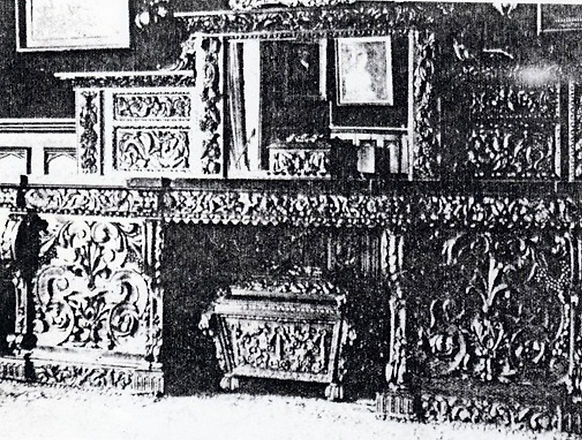
From Jack Branston's "Pennine People and Places" p26
THE BILLIARD ROOM
The current owner of Broomhead, Reginald Henry Rimington Wilson, is an exceptional billiard player. The billiard room is in the south-west corner of the house. It is a nice, bright room and contains several very interesting mementoes, in addition to the billiard table. There is a large glass cabinet in this room which contains a wonderful collection of chessmen, elaborately and faultlessly carved in gold, silver and bone enamel. There are dozens of sets from all over the world, including some from India and China, all collected by Reginald Henry’s father James Wilson Rimington Wilson, who died in 1877, who was also a very good player. He also amassed over 4,000 books on the game of chess, which are in the library.
There is an oil painting on wood of Broomhead Hall, which originally hung over the fireplace of the earlier Hall. It had been painted onto an oak panel, and when the Hall was rebuilt in 1831 it was taken out and framed and then hung in the billiard room. Another picture on the wall is the world-famous sporting picture “The Big Pack” by Mr. Archibald Stuart Wortley.
There is an old mirror hanging on one of the walls in the billiard-room near the “spot” end of the billiard table, about two feet square, about which the owner likes to tell a tale. I understand that the story involved a frequent visitor to the Hall, the Rev. Dr. Alfred Gatty, who is the vicar of Ecclesfield, and that it took place in the 1890s. After dinner one evening, Mr. Rimington Wilson was practicing nursery canons on the billiard table and Dr. Gatty was getting rather bored, his companion having made several hundred consecutive nursery cannons [1]. Several old-fashioned pistols had been hung above the fireplace for many years, and as Mr. Rimington Wilson was stood at the billiard table Mr. Gatty took down one of a pair of old duelling pistols to examine it, unaware that it was still loaded. Having cocked it, he playfully pointed it at his own reflection in the glass on the opposite wall, saying, “Ah! If that was a burglar, I think I could stop him!” He pulled the trigger, expecting only to hear a snap as the hammer fell, but much to his astonishment, and still more to that of Mr. Rimington Wilson, the pistol went off, with the result that the bullet, after passing some six inches above his host’s head, hit the mirror. And there the bullet remains amid some starred glass, serving as a warning to men – parsons in particular – not to play with things they do not understand, least of all loaded weapons.
Some paintings by Thorburn ; an old painting over the fire-place of shepherds, sheep and goats; an old painting of the house as it used to be, and one or two more pictures, conclude the description of this room [2].
[1] A nursery cannon is a carom shot involving balls which are very close together. A Carom is a shot in which the ball struck with the cue comes into contact with two or more balls on the table. The Oxford English Dictionary states that the earliest known use of this phrase was in 1893.
[2] Archibald Thorburn, FZS (Fellow of the Zoological Society of London), 1860-1935, a Scottish artist who specialised in wildlife, usually in watercolours
Below: The Big Pack, by Archibald Stuart Wortley
Reproduced in British Game Birds and Wildfowl by Abel Chapman and others, London MCMXII (1912), p68
In game shooting, a “big pack” refers to the natural phenomenon where smaller family groups of wild game birds, particularly Red Grouse, merge into massive, combined flocks during the late summer and autumn. These large flocks can number anywhere from 50 to over 200 birds. They form in response to cold weather, natural predators, or the pressure of being driven over shooting lines.

GUNS AND TROPHIES
The family are keen grouse shooters, and there are many guns kept at Broomhead Hall, including the Rolls Royce of guns, Purdeys. Mr. Rimington Wilson didn’t only shoot grouse. In 1880 he visited the island of Yezo (Japan) to hunt tigers, and he and his companion lost their bearings in the snow. He wandered aimlessly for two days and nights before he was found and was suffering so badly from frostbite that he had to have several toes amputated. His consequent lameness proved a severe handicap to his shooting ever after. Broomhead Hall contains many trophies of the owner’s skill as a shot. One of these is the savage-looking head of a wild boar which Mr. Rimington Wilson shot in Albania. An old farmer of the district, when shown the head, remarked, “I should not like to have to ring he.” Mr. Wilson once described Albania as “a most lovely country when no war is going on.” [1]
[1] Sheffield Daily Telegraph 16 June 1913, p8, a report of a visit to the Hall by the Hunter (Sheffield) Archaeological Society
In 1985 a three hundred-year-old chair which had belonged to the Wilsons went on permanent display at the Bishop’s House, Meersbrook. The walnut armchair was made in the 1670s, and was part of the furniture at Broomhead Hall until it went to a family in Stannington related to the Wilsons before being passed to a great-niece in Stockport, and then to the City museum in Sheffield. The photo shows Sheffield Polytechnic students Janet Mann and Liz Dumain with chair and was printed in the Sheffield Daily Telegraph 17 May 1985, p5

THE CELLARS
When James Rimington built the third Hall in 1831, the cellars of John Wilson’s 1773 Hall were not disturbed, the new house being built on the foundations of the older one. What is interesting is that, in 1906, when Mrs. Rimington Wilson died, the wine cellar was thoroughly overhauled, and some of its contents had not been disturbed for three-quarters of a century, probably more. Joseph Kenworthy reported that “there were liquors of lineage so ancient that they had lost all the qualities essential to a correct definition. Only, in a few instances, did sufficient flavour remain to aid the expert in his perplexity.” Rather poetically, he wrote that, “the skirts of more than one good housewife of the past must surely have been heard to rustle in the farthest reaches of that ancient crypt, when their shades heard a voice declare that a large percentage was the strong ale of a past age. An ale whose natural fire had matured and died within those well-corked bottles, the glass of which had been born in the still fiercer heat of Bolsterstone Glass Works.” There were, apparently, hundreds of such bottles, no two of which were exactly alike, and it was almost certain that they were made from Bolsterstone Glass. Kenworthy wrote that they were so old they had an illusive blue tint, which spoke of the slow but sure dissolution of the glass itself. It was thought that some of the bottles contained birch wine, which was once regarded as an appetizing drink, good for the digestion.

Kenworthy, Joseph: The History of Stocksbridge & District, Handbook 6 Bolsterstone Glass House pp43-45, 1915
That concludes our tour of Broomhead Hall, and we must thank our host Mr. Reginald Henry Rimington Wilson for his hospitality.
JOHN WILSON THE ANTIQUARY'S COLLECTION
For many years John Wilson’s huge collection was housed in a room at Broomhead Hall. He had left a strict charge upon his family that his work should be preserved with great care, and a room at Broomhead Hall was set aside for that purpose. The collection was later moved elsewhere before being sold in 1843.
Local historian Joseph Hunter, who was born in 1783, four weeks after Mr. Wilson’s death, was first granted access to the Collection in 1806, by John’s son William Wilson of Sheffield.
Hunter wrote, “I heard then that there was an immense mass of papers of various descriptions, the nature of which no one understood, stowed in boxes and drawers which filled a room at Bromhead Hall [sic], and which it was supposed no one had ever examined, since the death of the collector.” Mr. Hunter was allowed access to these papers, and promised to make a catalogue of them in return. In this year, the house was being let to a farmer, the owner, the Antiquary’s eldest son John, being resident in London. John died in 1810.
Mr. Hunter remained at Broomhead Hall until the end of the week. He focused on the larger manuscripts, not having the time to look at the charters, letters and other papers. Hunter was again granted access to the Collection in 1807, by which time the papers had been removed from Broomhead to a garret in the house of the Antiquary’s youngest son William Wilson’s house, in Pond Street, Sheffield, described by Hunter as “a small, inconvenient room.”[1] As Mr. Wilson got to know Hunter better, he allowed him more access, allowing him to remove some of the papers so that he could transcribe them. He was still visiting Mr. Wilson and dealing with the manuscripts into 1816 when he determined to print a Topography of Hallamshire, which he did, publishing it in 1819.
When William Wilson died in 1829 the Collection passed to his eldest son, also William, who lived at Fentonville, a house in Sharrow Lane, Sheffield. William removed the Collection to his house and sold it in 1843. Hunter lamented the fact that the younger son James, a solicitor who lived at Brinkcliffe Tower near Sheffield, did not inherit, because he believed that James would have kept the collection or ensured it remained entire. When the sales notice appeared in the newspapers Mr. Hunter wrote to Mr. Wilson at once, returning something he had mistakenly hung onto, and expressing his regret that the collection should be allowed to be dispersed, and lamenting the fact that “no public body or private association could be formed, who would keep in the neighbourhood such a valuable body of documents,” and also that he himself could not offer what might be deemed an adequate price. His only consolation was that, on receiving a sales catalogue, he saw that the Collection was to be sold as a whole lot, and not split up. Mr. Hunter himself was mentioned the sales advert.
This one was printed in the Sheffield Independent 24 June 1843, p4 and advertises that Mr. Wilson was leaving Sheffield on account of ill health and informing people that there would be a sale by auction at his residence at Fentonville, Sharrow Lane, near Sheffield of household effects and “Also, the splendid and unrivalled collection of manuscripts, formed with unwearied zeal by John Wilson, Esq., formerly of Broomhead Hall, and to which the Rev. Joseph Hunter was indebted for a great portion of his “Hallamshire,” in which Work, at Pages 275, 276, and 277, is a copious description of these Documents, and also a well merited eulogium of their value. Also, the collection of ancient pictures, (chiefly portraits) of remarkable rarity; and the collection of matchlocks, bows, armour and implements illustrative of early English warfare; and of other articles of high interest to the antiquary, as also formed by the late Mr. Wilson, of Broomhead Hall.”
Writing in 1843 Hunter recalled that several London booksellers were at the auction. He had been willing to bid £50 for them, and it was believed there were bids from the Wilson family, but eventually a Mr. Thorpe bid 165 guineas, and he took the collection down to London. “Thus in a moment is dispersed what it took a whole life to collect, and such a collection as I hardly exaggerate when I say has not, I believe, been made in any other part of the kingdom. I, at least, never saw anything like it. The loss is infinite, and I cannot close this last story without adding that I cannot think the present Mr. Wilson has satisfied what was due to his family and to his birthplace. It may be that the demands upon him for money are urgent. I know not how that may be, but before he proposed selling them by auction he should, I think, have signified his wish to dispose of them, and given the option of purchasing to his family, to the present possessor of Broomhead, or to some society or spirited person, like Mr. Young, at Sheffield. But I will hold my hand, remembering the long experienced kindness of his most worthy father.” Joseph Hunter 1843
An article in the Sheffield Independent reporting the sale noted that, “it is much to be regretted that they were not purchased by some of our townsmen, for, to quote the words of the Rev. Joseph Hunter, (the historian of Hallamshire), as expressed in a note relating to the M.S.S., which Mr. Bardwell [auctioneer] read previous to the sale of them, ‘they should be purchased and deposited in some public building in Sheffield, and bear the name of ‘the Wilson collection’ in honour of him who formed it, as it has fallen to the lot of few places to owe so much to one individual, as Hallamshire does to Mr. Wilson.’” A Roman plate found at Stannington, “an interesting relic, but in a very crumbly state” fetched £5 10s. [around £564 today] and other curiosities, which were said to be of minor interest, brought high prices.
In an article in the Yorkshire Archaeological Journal, 1879, it was said that the collection passed from Mr. Thorpe to a prolific manuscript collector called Sir Thomas Phillipps, Baronet, of Middle Hill, Worcestershire. It was noted that Joseph Hunter’s memoir about the access he gained to the documents did not accompany the collection. This memoir was printed in that Journal.
In the late 19th century, the Wilson family repurchased the Collection from the Phillipps estate. In 1953 the family made a final sale of the manuscripts, which lead to their dispersal into institutional and university archives. Some of the records are now held in the University of Leeds Libraries Special Collections.[2]
[1] The oldest son John died in 1810; second son Joseph died in India; third son William lived in Leeds and died in Sheffield in 1817, which is how the fourth son William, a spirit merchant living in Sheffield, came to have ownership of the Collection.
[2] https://archiveshub.jisc.ac.uk/search/archives/27506411-ef57-3637-85a1-c3a76cdfd537
Postscript: Sales of items from Broomhead Hall
1922: Guns
In 1922 Reginald Henry Rimington Wilson (1851-1927) put some of his guns up for sale by auction. Three single-trigger, double-barrel, hammerless twelve-bores, by Purdey, were sold for £189. The Bank of England’s currency converter estimates this to equate to around £9,534 today, 2026.
1928: The Sporting Library
In February 1928 two sales took place at Sotheby’s in London. The first sale took place on 27th February and was devoted to the “sporting and general library.” The auction attracted a large crowd of dealers and collectors, bidding was brisk, and prices were good. Around 240 lots were sold in three hours, realising approximately £2,000. This library was not as famous as the chess library, but there was a lot of interest, and it included works on almost every conceivable form of outdoor and indoor sport. Many of the volumes were original or first editions, the majority being of considerable antiquity and perhaps worth more as antiques than as reading matter. Subjects included angling, fencing, the prize ring, shooting, riding, and ornithography[1] as well as lesser known “sports” such as dice-throwing, back-gammon, and the art of legerdemain.[2] With these treatises on various forms of amusement are interspersed books of witty stories and chronicles of the adventures of adventurous young men in the London of olden days. One book by Thomas Wilcox, “A Glasse for Gamesters,” published in 1581, not in great condition, was bought for £92 by a Mr. Maggs, who bought some the chess library.
1928: The Chess Library
The world-famous chess library went to auction on the 29th February. A bound manuscript copy of Oliver Goldsmith’s translation into English verse of “Vida’s Fame of Chess,” which Mr. Rimington Wilson purchased from Mr. Ellis, a well-known London bookseller, for fifty guineas 1871, fetched an enormous £5,600, realising that figure within sixty seconds of the first bid. The Bank of England’s Inflation Calculator estimates this to equate to around £306,868 today. It was bought by Mr. Maggs. It was generally assumed that this would ultimately find its way to America, but Mr. Maggs, who bought many of the more expensive pieces from the Broomhead collection, said he was undecided as to its fate. A number of early manuscripts of Jacobus de Cessolis[3] fetched big prices, and three of them alone realised a total of £635. Some of the books dated back to the 15th century. A first edition of Arthur Saul’s “The Famous Game of Chesse-play” was sold for £115. The British Museum and Bodleian copies of this rare English book are the only others known. The total for the afternoon reached approximately £8,000, which, with the price realised at the sporting and general library sale, was around £10,000.
[1] The scientific description of birds, and their lore, symbolism and mythology
[2] Sleight of hand, artful trickery, conjuring
[3] Jacobus de Cessolis was an Italian author of the most famous morality book on chess in the Middle Ages. In the second half of the 13th century, Jacobus de Cessolis, a Dominican friar in Cessole used chess as the basis for a series of sermons on morality.
DEMOLITION
Broomhead Hall was last occupied by Captain Reginald Rimington Wilson and his family in 1939. After this he spent most of his time at his home near Cirencester, for Broomhead became too costly to run. Part of it was used as a school during the Second World War and the Rimington Wilsons visited for a few of the war years, although they seem to have stayed in one of the estate cottages.
The Hall was commandeered by the Armed Forces during WW2 and it is said that the service personnel ruined the Hall’s interior, the wooden panelling, the flooring, and so on. The last people to occupy the building were the farm workers who lived there in flats.
In 1977, the Huddersfield Daily Examiner reported that, after a seven-year fight, Reginald de Rodes Rimington Wilson was given permission by the Peak Park Planning Board to demolish the Hall, which had not been lived in since his father [Henry Edmund, who had died in 1971] had left “thirty years ago” [c1947].
At the time Mr. Rimington Wilson was living near Cirencester. He told a newspaper reporter in 1976 that the house was in a very bad condition and the cost of heating it was prohibitive, so that it would be better to knock it down and build a new house on the site.
The contract was awarded to Nigel Lindley and his company Linbros Demolition Ltd. I am told that the demolition did not take place until (probably) 1980. Initially there had been a request that the façade be rescued and there is still talk locally that it had been shipped off to America. However, this never happened. In an article published in the Sheffield Morning Telegraph in August 1977, Rob Firth wrote that Mr. Lindley had been approached by a London agent acting for an (anonymous) “Arab oil sheik” to prepare an estimate of how much it would cost to transport the façade to Arabia. The exercise would take about six months to complete, with each stone being carefully taken down, numbered, and a master plan made for the reconstruction. In a similar article in the Huddersfield Daily Examiner, the cost of this careful demolition was estimated to be in the region of £20,000, plus transport costs. Mr. Lindley said that “if London Bridge can be rebuilt in America, I am sure we can deal with [the Arab’s] unusual project.”
Mrs. Lettie Marsh, of Hollin Busk Lane, Deepcar, who had worked as a nanny at the hall for eight years, told a reporter: “It is a tragedy that the hall is coming down. In its heyday, it was a fabulous place with ten bedrooms, a marvellous staircase and library. I always hoped that it could be restored. It is a fine building.” She added that it was not much consolation to have part of it preserved in a “far-off country.”
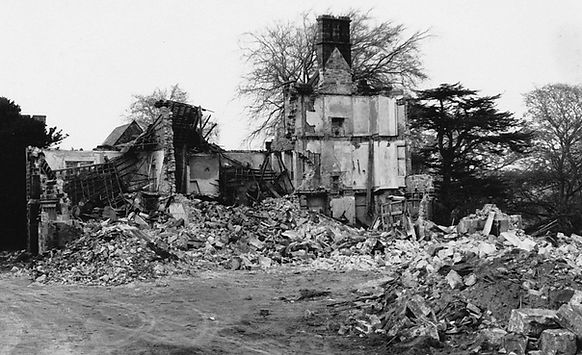
In the end, this did not happen, and a wrecking ball was used to demolish the building in the usual way. Mr. Lindley had received many inquiries for parts of the historic hall. Huge oak beams were going to Holland where a family firm wanted them for church restoration, and a London barrister was interested in some windows and stone. Most of the stone was used locally. The outbuildings were not pulled down at the same time, and were still there in 1987 – the website Picture Sheffield has several photographs taken in this year. The foundation stones were left in situ. Writing in 1978, Country Life Magazine said, “all that remains [of the Hall] today is a pair of gateposts.”
Below: the top photo and the one with the wrecking ball show Broomhead Hall partly demolished in 1980. The tall section was left standing until the late 1980s and it was still possible to climb the stairs. © Chris Spenceley, shared with permission
The bottom photograph is from Picture Sheffield ref. s33358 (erroneously labelled as 1972)


TIMELINE / OCCUPANTS OF THE HALL
THE 1640 HOUSE
This house was built by Christopher Wilson, who was born in 1595. He married Mary Ibbotson and was a Captain in the Parliamentary Army during the Civil War. He died in 1671.
Christopher’s first son Thomas Wilson was born c1626. He died unmarried in 1687. The pedigree in Hunter’s Hallamshire states that Christopher’s second son was Charles Wilson, who was baptised in 1631 and that “The estate at Broomhead was settled upon him in 1659” – this was before his brother Thomas died. This is because Thomas was becoming incapable of managing his affairs. On the 28th 1659, Christopher Wilson made an entail of his estates, and made provision of 30 shillings a year for Thomas, to be paid out of the estate. Charles was the rector of Babworth, in Nottinghamshire, and later became vicar of Sheffield until he resigned in 1695 and retired to live at Broomhead, where he died in 1703. He was married to Anne Allott.
Charles’s eldest surviving son was John Wilson, who was born at Kimbolton, near Huntingdon, in 1672. He married Mary Macro and died in 1735.
THE 1773 HOUSE
John and Mary’s only surviving son and heir was John Wilson, 1719-1783, who became the well-known Antiquary. He was Christopher’s grandson. It was John who rebuilt and enlarged the 1640 house, which was completed in 1773. He married Susanna Oates and his eldest son was called John. John and Susannah also had the following children:
Joseph Wilson, born in 1749 and who died unmarried in the service of the Hon. East India Company in Bengal
Thomas Wilson, born in 1752[1] and lived at Armley, near Leeds. He died in Sharrow, Sheffield in 1817
William Wilson, fourth and youngest surviving son. Lived in Sheffield and was one of the twelve capital burgesses of Sheffield;[2] he became the owner of his father’s Collection. He died in 1829. It was William’s son, who lived at Fentonville, Sharrow, who sold the Wilson Collections in 1843. He died in 1847.
Two sons, Charles and Richard died in infancy
John Wilson: 1787-1809 or 1810
John the Antiquary’s son lived in London where he was a solicitor, and he did not live at Broomhead. When local historian Joseph Hunter visited Broomhead in 1806, having been given access to the Antiquary’s Collection, the Hall was inhabited by a farmer, who was a tenant of the Wilsons. On his first day there, it was the first day of grouse shooting (12th August), and James Rimington was at the Hall. Hunter wrote, “I reached Bromhead between six and seven, before the sportsmen, with whom the house was filled, were out upon the moors. Of the persons there to enjoy the sport, I remember only Mr. James Rimington, whose mother was a Wilson, and who, in the course of time, became the possessor the Bromhead estate, pulled down the old house, built the present very handsome mansion, and has now been dead two or three years. The house was at that time inhabited by a farmer, who was a tenant of the Wilsons, and whose name I have forgotten.”
When John died in 1809 or 1810[3] he left the estate to his wife Rebecca, who sold it to Henry Wilson of London, a relative from a younger branch of the same family.
THE 1831 HOUSE
Henry Wilson: c1759-1835
Henry’s grandfather Christopher Wilson was a younger son of Charles the vicar and Anne Allott. Henry Wilson does not seem to have lived at Broomhead; according to the pedigree printed in Hunter’s Hallamshire (published in 1819) he was a merchant in the City of London. Instead, it seems he put his nephew James Rimington in charge, and it was James who oversaw the redevelopment of the Hall, which was finished in 1831. James was the only child of Mary Wilson and John Rimington of Sheffield and Hillsborough . Henry Wilson was a bachelor, and when he died in 1835 he left the property to James, on condition that those succeeding him should take the surname of Wilson; hence the occupants became known as the Rimington Wilsons (no hyphen).
James Rimington: 1796-1839
James was married to Sarah Broomhead and was a barrister. He lived from 1786-1839, dying four years after his uncle. James had attended Trinity College, Cambridge, and was a barrister-at-law and Justice of the Peace for the West Riding of Yorkshire. He died at Broomhead in September 1839 aged 52.
Henry Rimington: 1820-1849
Upon the death of James in 1839 the house passed to his eldest son Henry Rimington, born 1820. He died in Madeira in 1849 and the estate passed to his brother James Rimington Wilson.
James Wilson Rimington Wilson: 1822-1877
In 1840, when he was still legally a minor, James’s guardians were granted permission that he, James Wilson Rimington, “in compliance with a direction contained in the last will and testament of his great uncle, Henry Wilson, of Upper Tooting, Surrey, Esq., deceased” could take the surname Wilson, “in addition to and after that of Rimington, and that he may use and bear the arms of Wilson …” and from then onwards the family were known as Rimington Wilson (no hyphen). He married Jane Wallas at the British Consulate in Madeira in 1849. James was, like his father, also a Justice of the Peace. James and Jane had two sons. Reginald Henry Rimington Wilson was born in Madeira in 1852 and died at Broomhead Hall 31 March 1927. Henry Rimington Wilson was born in 1854 and died in 1915. They also had a daughter Harriot Mary, later Lady Moncrieff.
Reginald Henry Rimington Wilson: 1851-1927
Reginald Henry was educated at Eton and Trinity College, Cambridge. For some time he held a commission in the 6th Dragoons and also travelled extensively, but he spent the greater part of his life as the squire of Broomhead. He was also a magistrate for the West Riding and Lord of the Manor of Bolsterstone and patron of the living [of the church]. He also had an estate at Newstead Hall near Hemsworth. Reginald Henry never married, and his younger brother had pre-deceased him, which meant that the estate passed to his nephew Henry Edward Rimington Wilson, the son of his late brother, who was at the time an officer in the Guards.
Henry Edmund Rimington Wilson: 1899-1971
Henry Edmund Rimington Wilson was born in Belgravia, Westminster, in 1899. He attended Boarding School in Eastbourne and then attended Eton College, leaving there in 1917. He was a 2nd Lieutenant in the Grenadier Guards during the Great War, and was promoted to Lieutenant in 1920, later being promoted to Captain. When the 1921 census was taken he was living in the Waterloo Barracks at the Tower of London and in 1926 he was living in Mayfair. Henry inherited Broomhead after the death of his uncle in 1927 and resigned his commission. A year later he married Felicity Locker-Lampson (1906-1989) in 1928, and they made their home at the Hall, although their three children were born in London in 1929, 1930 and 1933, at least one of them at the house in Belgravia. When the 1939 Register was taken he was living in one of the Broomhead Estate cottages. On the 3rd June 1940 he was made a Lieutenant in the Grenadier Guards. He was a West Riding magistrate, and president of the Stocksbridge branch of the British Legion, as well as being lord of the Manor of Bolsterstone, and patron of the living of Bolsterstone with Deepcar.
When he died on 27 February 1971 he was living at 55 Park Lane, London.
Reginald de Rodes Rimington Wilson: 1929-1993
Reginald was the son of Henry Edmund and Felicity. He married Felicity Constance Irene Lawford in London in 1961. At the time he was living in Kensington & Chelsea. It was he who sought permission to demolish the house, which was granted in 1977. At the time Mr. Rimington Wilson was living near Cirencester. He told a newspaper reporter in 1976 that the house was in a very bad condition and the cost of heating it was prohibitive, so that it would be better to knock it down and build a new house on the site. He died in Sussex in 1993 aged 63 and left over £1 million (£1,602,333)
[1] The date in Hunter’s 1819 edition of Hallamshire is 1652, an obvious misprint, which is corrected to 1752 in Gatty’s 1869 edition of Hallamshire.
[2] See http://www.sheffieldchurchburgesses.org.uk/history-of-sheffield-church-burgesses-trust.htm
[3] Sources differ. FMP has a burial for a John Wilson buried St. James, Hampstead Road, Middlesex buried 29 November 1810 aged 63, born c1747. Hunter/Addy have St. Andrew Holborn. i Can’t find out for certain
WW2 AND BEYOND
War was declared on the 3rd September 1939. On the 29th of September a kind of census was taken, known as the 1939 Register. The information gathered was used to produce identity cards and, once rationing was introduced in January 1940, to issue ration books. Information in the Register was also used to administer conscription and the direction of labour, and to monitor and control the movement of the population caused by military mobilisation and mass evacuation. Military personnel were not recorded.
Broomhead Hall was recorded as a “Temporary private boarding school,” with sixty people being recorded, there being 45 pupils and 15 staff. Quite a few of the individual records are redacted, and these will not be made visible until either the person’s death has been notified, or until 100 years has passed since they were born.
Girls’ and women’s future married names are also recorded, because this Register continued to be used for administrative purposes well after the war had ended. Below is a list of those in residence on the 29th September, future married names in brackets:
Matron: Helen Middleton
Assistant Matron: Carol E. Dove [Rudyard]
Headmaster: George B. B. Johnson, and his wife A? Johnson
Teachers / School Masters: Jessie Howarth [Dann], Elsie Becker, Michael E. Peachell, Dan G. D. Chamberlain, John H. B. Roberts
Pupils: David D. Howarth, Michael Gardner, Philip J. Childs, Charles A. E. Davis, Benjamin G. Gradwell, Walter S. Lewis, John F? Lewis, Joseph H. Lockwood, John Lockwood, Brian L. Simpkin, Ian B. Spafford, John R. Walton, Frank D. Johnston, Douglas Keith Gardiner. At the time of writing [June 2026], 31 pupil names are still redacted. Total: 45
Cook/housekeeper: Elsie Moorhouse
Domestic servants: Agatha Kirk [Anderson], Constance Kirk [Hall], Joyce Williams, Sylvia Wainwright, Alice Turner [Stubley]
The next schedule is “Broomhead Cottages,” and it was in one of these that Henry Edmund Rimington Wilson was living with his two children [names redacted], a governess called Violet M. Hobbs and a schoolroom maid Winifred Jackson [Dyson]. Henry’s occupation was recorded as “running country estate” and additional information about war work said that he was an Army Officer in the Grenadier Guards, Emergency Reserve. . His wife was not with him; she was at Little Rowfant, Crawley, West Sussex. She and an Ellen Seidler were “of private means” and they employed a maid and a cook.
A second cottage was in the occupation of Arthur Senior, who was a chauffeur/mechanic, as well as the supplementary role of West Riding County Council “Air Warden” [air-raid warden].
The Hall was commandeered by the Armed Forces during WW2, and they were there until 1946. Hundreds of women from the A.T.S., W.A.A.F.s etc. were stationed there during the first part of the war, before being moved out, to be replaced by men from the Armed Forces. The A.T.S. were possibly billeted in tents in the grounds, and if they wanted a drink, the nearest pub was the Castle Inn at Bolsterstone.
The A.T.S. was the Auxiliary Territorial Service, the women's branch of the British Army during WW2. It was formed on 9 September 1938, initially as a women’s voluntary service, and existed until 1 February 1949, when it was merged into the Women’s Royal Army Corps. As more men joined the war effort, it was decided to increase the size of the A.T.S., with numbers reaching 65,000 by September 1941. Women between the ages of 17 and 43 were allowed to join, although these rules were relaxed in order to allow Women’s Army Auxiliary Corps veterans to join up to the age of 50. The duties of members were also expanded, seeing A.T.S. orderlies, drivers, postal workers and ammunition inspectors. In December 1941, Parliament passed the National Service Act, which called up unmarried women between 20 and 30 years old to join one of the auxiliary services, one of which was the A.T.S. Married women were also later called up, although pregnant women and those with young children were exempt.
All the park was ploughed up to grow food as was an area on the west side of Mortimer Road after the heather, scrub and trees had been removed and burnt. Some of the rooms were used for storage of grain and potatoes during the war.
The celebrated bomber pilot Guy Gibson spent a short time at Broomhead Hall when 617 Squadron were practicing for the Ruhr Dams raid, “Operation Chastise, ” which took place on the night of 16/17 May 1943. Wing Commander Guy Gibson, who was only 24 years old, led his men on a top-secret mission to bomb three dams in the Ruhr Valley, but before this could happen, the crews had to practice, and our local dams were where this took place. The men practiced dangerous, low-level night-time flying, initially with practice versions of Barnes Wallis’s “bouncing bombs.” Most people associate nearby Derwent Dam with the Dam Busters, but Gibson and his crews also practiced over our local reservoirs including Ewden and Langsett. The so-called “Dam Buster” raids became the stuff of legend and were a real morale booster for the British people. Gibson won the Victoria Cross for his actions.
“When Britain decided that the way to incapacitate the German production line was to breach their reservoirs British planes used the local reservoirs for practising. They used the Langsett, Ewden, Bradfield and Derwent Reservoirs for practice runs and Guy Gibson who led the command stayed at Broomhead Hall at the head of the Ewden Valley with the Remmington Wilson family to oversee the practices.”[1]
After the bombing of Sheffield in 1940 an Insurance company relocated to the hall so that they could carry on their work.
[1] There’s a piece in the “Peoples War” archive by the BBC, which mentions Guy Gibson being billeted there during the dam-busters training. https://www.bbc.co.uk/history/ww2peopleswar/stories/29/a2063729.shtml
Written by Mrs. Nunn, Malcolm Nunn’s mother (Malcolm from Bradfield Archives)
Click on a photo to enlarge it, and for more information


SOURCES
Anderson, Neil: Sheffield’s Date with Hitler, ACM Retro Ltd., 2020 pp91-2
Bradfield Historical Society: Bygones of Bradfield Vol. II pp54-6, Hilltop Press (Sheffield) 1988
Branston, Jack: Pennine People and Places, privately printed (after 1983)
Hey, David: Historic Hallamshire, Landmark Publishing (Ashbourne), 2002 pp. 58–9
Holland, John: A Tour of the Don, 1837, pp136-128
Hunter, Joseph: Hallamshire, the History and Topography of the Parish of Sheffield (1819 edition). Broomhead Hall and pedigree of the Wilson family pp275-279
The Rev. Dr. Alfred Gatty published a revised and updated version in 1869, pp471-476; the paragraphs about Broomhead Hall are almost identical, but the later edition has an updated pedigree for the Wilsons and a new one for Rimington of Broomhead Hall (p476)
https://babel.hathitrust.org/cgi/pt?id=nnc1.ar53748832&seq=11
Jackson, Charles (ed): Yorkshire Diaries, Surtees Society 1877; this volume contains the Diary of Adam Eyre
Kenworthy, Joseph: The History of Stocksbridge & District, Handbook 6 Bolsterstone Glass House pp43-45, 1915
Kenworthy, Joseph: The History of Stocksbridge & District, Handbook 15 Bolsterstone, privately printed, 1915
Kenworthy, Joseph; articles printed in the local newspapers, available at Findmypast or the British Newspaper Archives
Ownsworth, John: Penistone & The Peak District in Wartime, self-published, p60
The Yorkshire Archaeological & Topographical Journal, Vol V, London 1879, pp63-125
-
Prefatory Letter to Wilson’s Yorkshire Deeds by Hunter (1843) pp64-68
-
A Memoir on the Origin, Descent and Alliances of the Ancient Family of Wilson of Bromhead by Hunter (1824) pp70-110
-
John Wilson’s Yorkshire Deeds, the Wilson genealogy, Wilson’s collection of Charters etc, Schedule of deeds relating to Bromhead and the Wilsons. Written by the late Rev. Joseph Hunter, LL.D., F.S.A. in 1824]
Article in the magazine Land and Water 3 Sept 1904
Final page(s) of the article is missing. Sent to me by Julia Tompson
Newspapers at Findmypast, also available at the British Newspaper Archive
The London Gazette, at Findmypast
With thanks to Julia Tompson, Rob Firth, Julie Rutter, Chris Spenceley, Dawn Coultas, Andrew Jordan, Dave Woods, Diane Hague Ripley, and those who wish to remain anonymous but have shared information.
Further Reading:
David Hey cites a book by D. Wilson, A History of the Wilson Family of Broomhead (Sheffield, privately printed, 1991)
An album of photographs of Broomhead Hall by C. H. Lea, 1942 (Sheffield Local Studies Library: 728.8 SST) from which some of the photographs on Picture Sheffield have been taken
Notes:
John Wilson lived 1719-1783
Joseph Hunter lived 1783-1861 – he was born exactly four weeks after Mr. Wilson’s death
The Rev. Dr. Alfred Gatty lived from 1813 until 1903. He became Vicar of Ecclesfield in 1839 and remained in that post for the rest of his life (63 years). He was almost 90 years old when he died. He published an enlarged edition of Hunter’s “Hallamshire” in 1869 and wrote “A Life at One Living” in 1884.
His son, Reginald Alfred, was born in 1844 and was vicar of Bradfield from 1869 until 1888. He died in 1914
In 1869 Bradfield became an independent parish (it had previously been a Chapelry of Ecclesfield Parish) and the Rev. Dr. Alfred Gatty chose his son, Reginald Alfred, to be its first Rector. He served the Bradfield community for twenty years until moving to Hooton Roberts in 1888.
© Claire Pearson 2026; you may share information but please provide a link to this website